Tuesday, March 25, 2014

West Side Story: On Stage and In Film


All right, Going back to the last class one thing that interested me was when Dr. Mitchell-Buck mentioned that the America scene was different in the play than it was in the movie. Specifically that in the play the America song was done only by women. I found that interesting so I looked it up on youtube. And to no surprise, Dr. Mitchell-Buck was right.

I find this interesting  because it creates a different mood and feeling than that of the movie's scene. In the movie the song is sung as an opposition between the male gangsters and the females. While both a united by a racial identity, they seem clearly divided over their feelings about America. This gives the gang more of a motive and makes them more sympathetic. However the theater version has the opposition and support for America singularly in the hands of the girls. By doing this it removes the gang dynamic but creates a more unified feeling for the Puerto Ricans as a whole. Instead of dividing the complainers and supporters along gender lines, it makes the it difficult to tell who supports and who opposes America. It makes the Puerto Ricans able to see both sides of America. To be fair it could be argued that the movie version does that as well, but by making it one group both singing for and against America this group seems more unified in their opinions of America as a whole.

The movie version though I feel is stronger though because the song gives the Sharks more of a motive and empathy, as well as allowing better banter, because of the gender dynamics.

Monday, March 24, 2014

I AM UPSET AND BETRAYED!

So, I have never read Pride and Prejudice before. I was actually actively avoiding reading it because it has that same aura that The Great Gatsby has. That "stupid wealthy white people doing things that are pointless" aura. I get the point of Great Gatsby and Mrs. Dalloway, they're writing a narrative about how crap these people are and their actions. But my issue is that people eat this universe up. There are Gatsby parties where people dress up and are useless. USELESS!


Okay, so anyway, I wasn't stoked to start this book. And then I started it. And I still hated it.


Hate is a strong word but I'm gonna use it anyway. I really hated these people (expect Mr. Bennet. I will get Mr. Bennet tattooed on my ass I love him so much) and what they didn't do and how they are nothing but useless lumps of flesh. I sat in the English department and told anyone who passed by that I was in pain. 

Reasons why I hated P&P in the beginning:
  • Throwing shade
  • Obsession with marriage
  • Rude behavior
  • Regency era stuff that I don't understand and then just got upset about.
  • The class system makes me want to spork out my eyes
So, there I am, inspiring English professors on making a class based around useless white people when I decided to ask. Why? Why do people like this book? (Please answer for yourself if you like this book, I want to know!)


Dr. Sandona's answer is that he really likes the way that it's written. The language is really appealing and he appreciates how Austen created this world for readers to escape to during the Napoleonic Wars (Personally, this world sounds like a special ring of hell).

Dr. Mitchell-Buck was all about the narrator. Having a snarky narrator who tells the story but gets punished/chastised for it is refreshing and rewarding. 

I didn't officially ask Dr. Orloff but she digs Jane and hates Mr. Collins and Mrs. Bennet. 

These are good answers. I appreciate them and they have helped me get through the book. Once I was on a roll I kept myself going. With the aid of Mr. Bennet and a pen I marked my way through the book. What super helped me were The Lizzie Bennet Diaries.


I fell in love with the characters, I fell in love with the way the story was crafted, I fell in love with the story changes, and totally fell in love with the LOVE! I was so friggin' stoked for all the little romances and it made me turn to the book with new happiness and excitement.


Then I got to thinking. No one put romance at the top of their list as to why they liked this book. Before reading this book I had seen that Keira Knightley movie so i was expecting some awesome love action in the rain and stuff.


Look at that! Look at that deceleration of love and stuff! That's what I was expecting from the book. Nope. It was not nearly as romantic as I wanted it to be. My romance boner was gone.

 
They take a walk in the garden, go over how they had once perceived each other and how they have not changed, and then they part ways APPARENTLY ENGAGED. WHAT? I SO CLEARLY DON'T UNDERSTAND THIS TIME PERIOD. HE DIDN'T ASK HER TO MARRY HIM! WHAT IS GOING ON!

How did this happen? Someone with a history boner needs to tell me when it was unacceptable to have the spicy-sauce relationships that Shakespeare wrote and replace it with this passive romance. It was such a let down for me that the ending is actually ruined. THEY DON'T EVEN KISS....WHAT?! THAT'S NOT EVEN WHY I'M UPSET. I mean, look at this chemistry!


THAT IS A CUTE SPICY MEATBALL! I was expecting this from the book, and it let me down. 

Don't get me wrong, I am glad that I read the book. I can check it off my list and be in the in crowd of people that 'get' Pride and Prejudice (or fake it at least). I love how Austen does dialogue, Mr. Bennet is my homie, and the book totally wrapped me up in it's dramatics. I was laughing and faux-gasping as I read it which I haven't done in a good long while. I liked it but I probably wouldn't read it again too soon. Like, if I ever have a kid and they have to read it for class I might pick it up again just to keep the neurons firing. 


As far as the feminism in this book goes, I feel like its something that I will need the class to help me understand better. I see little snippets here and there that might be considered feminist but I can't get past that the entire society these people live in revolves around marriage. No matter what personality the men and women may have its all about how they're going to attached themselves to each other. I'm not seeing a who bunch of autonomy here. I mean, I am. The fact that Elizabeth can say no to Mr. Collins and Darcy is pretty impressive and autonomous. I dunno. THIS STUFF IS HARD!! Alright, I should go to sleep now, the cold medicine is hitting me now.


Feminism in Austen Novels

So after reading the article that was assigned for class tomorrow (“Giving Patriarchy its Due”), I started thinking about the role of females in “Pride and Prejudice” and the significance that they have on the story. 

All of Austen’s novels are set in the Regency Period (1811-1820) of England, a time when women were rendered voiceless under the hand of societal rules.  Women weren’t permitted to own or inherit land, travel alone, be in company of a man without a chaperone, or correspond via letters with a man for an extended period of time (unless engaged or married to him).


So basically, women were allowed to do nothing besides minding their own business and looking pretty.  Oh, and finding a suitable husband with a large fortune, of course.  But there was one thing women had the power to do.

They could say no.

That is what gives Austen characters their power and shapes their overall personalities, especially Elizabeth Bennett.  The fact that they are completely free to form their own opinions of men and to reject them at the drop of a hat allows the women of Austen’s world to subtly determine their otherwise predetermined future. 

In a word where women have no rights, Austen manages to give them a kernel of feminism in a male-dominated society.  The simple act of saying “no” is just the beginning of the feminist movement to come.


I believe that Austen knew exactly what she was doing when she gave her female characters this power and exploited their use of it in her novels.  In “Pride and Prejudice,” for instance, Lizzie doesn’t hesitate to loath Darcy, adore Wickham, and judge Caroline.  She voices her opinions and questions the motives of others.  And it’s interesting to see that most of her long harbored impressions of people turn out to be completely wrong. 


Though Lizzie does represent the female power in Austen’s novel, she is still human and makes mistakes.  Austen exactly pinpoints the various imperfections of women while maintaining their subtle power within society. 

Sunday, March 23, 2014

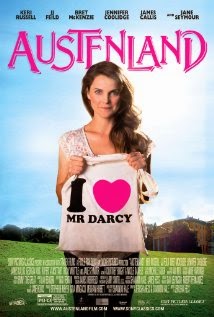
Austenland

I heard about this book a few years ago, but never read it. Now, there's a movie. Go figure. So, this weekend my friends and I watched Austenland. I'm going to be honest; I loved it. We laughed. We said, "this is ridiculous!" and all that good stuff. It was just a lot of fun all around. A few days later, my friend even said, "I could watch Austenland again right now."

 (I love Mr. Darcy, too!) 

The premise is that Jane (lol) is obsessed with Pride and Prejudice and unlucky in love, so she goes to Austenland, a resort of sorts where actors interact with guests and bring Jane Austen's world to life. I saw many parallels between what the actors were doing and saying and various scenes in Austen's novels. Catching those moments is always a bonus.


I still want to read the book, and I'm sure that I will. I think this is an interesting "take" on Austen in that it shows how people today still have strong reactions to her novels, because they do. Much like the Jane Austen Book Club, which I also like. It's one of those movies I can watch whenever I feel like it and not get bored. It's just so cute. I can get a bit of an Austen fix without watching or reading any of her books or their incarnations on film.

I genuinely enjoy the films that aren't modern adaptations of the novels but modern films where the books or films are incorporated. Lost in Austen is another one. The main character actually gets transported into Pride and Prejudice.

(All four episodes of Lost in Austen are available to stream for free and legally on Hulu right here; yay! -- I think I know how I'm spending my Friday night!)

The modern adaptations of the books are great fun, too: Clueless, Bridget Jones' Diary, and the good old Lizzie Bennet Diaries or the follow-up series of Emma.

Austen's novels have been interpreted in many ways and changed drastically for some of them. I will watch any Austen interpretation I can get my hands on.

I'm gonna go read some P&P fanfiction now.

Tuesday, March 18, 2014

Teen Love, Romeo+Juliet and the King Killer Chronicles

This is just a small random post. I am posting it here instead of in the Fandom journal, because it relates to our class discussion, and is more my thoughts than actions of the Fandom.

One aspect in our talk about Romeo and Juliet that I found interesting was the talk about them being teens. Many seemed to agree their love felt rushed, but that was somewhat acceptable because they were teenagers. Whether you agreed with whether their love was true, or would have faded away with time, The story itself doesn't seem to be hurt by it. You don't hear a lot of complaints that it is unrealistic, and it ruins the story because of it. In short, the rushed love affair seemed to be accepted because the individuals (Romeo and Juliet) were teenagers.

I find this interesting because in my fandom, the exact opposite is true. The main male and female characters  (Kvothe and Denna respectively) are obviously very interested in each other. For Kvothe, it is obvious because we have his perspective and  Denna has hinted, flirted, and in one case (while drugged admittedly) flat out said she liked Kvothe. And yet neither character has had the nerve to make a serious move. This has lead to some hatred or annoyance at  one or both of the characters but a lot of people seem to accept and even empathize with their relationship, because they are teenagers. You will hear comments like, well they're teenagers of course they're going to be shy.

I find it really interesting that both being really impulsive and being extremely cautious in a relationship can be related with the same, oh well they're teenagers. To be honest it sounds accurate to me, it was just something I found funny, and while seemingly paradoxical, accurate.

West Side Story and Warm Bodies


I had seen West Side Story a long time ago so I had almost no memory of it so I went in mostly fresh. I had heard it was good and after watching it I have to agree. It was a really good movie. It was also amusing hearing songs that I had heard before and finding out they're from this movie. But it left me with two big thoughts. Firstly Baz Lurhmann's felt a bit inspired by West Side Story, especially the opening sequence of his movie.

The Other interesting aspect for me was the changes that were made. One specific change seemed so small, but on reflection, has such a large impact on the meaning of the story. And that change, was the removal of parents. In West Side Story (WSS) the only real parental figures we see are Doc, and the police. And none of them are treated with any respect by the gangs.. In Shakespeare's Romeo and Juliet, much of the blame lies on the adults who did nothing to actually prevent the violence between their households from taking place. There was a lot of responsibility placed on them to uphold the peace and their failure to do so, caused the deaths to occur. But by removing those authority figures the blame for the deaths shifts from them to the gangs. They made the choice to pick fights and while death was never actually intended, they are the only ones are responsible for it. They lose any opportunity to hide behind the fact that it was their house's or families feud and have to accept that they were responsible for the deaths. It creates a very different dynamic because in Romeo and Juliet, the blame was on their parents for not ending the feud, and much of the tragedy lies in the fact that if the parents had ended their feud the violence could have been avoided. But in WSS the blame lies, if on any outside force, society itself. It creates a dynamic where those responsible (the gangs) seemed to have no power over what actually occurred. This makes the violence seem more inevitable, and in that light, makes the deaths more tragic.


Now on to Warm Bodies. Honestly, went in to it extremely skeptical. It did not seem like the sort of movie I would like. By the end I... I.... I didn't hate it. For the most part, while finding corny I enjoyed it. The main character was interesting as his zombie friend had some hilarious lines. However the main female lead, while attractive, I hated. Alright to be honest, I had been listening to the unabridged audio recording of World War Z (which is completely amazing and I highly recommend) and that work is a lot more serious and more recognizes hard choices have to be made sometimes. Which is why I absolutely despised the girl. She whines about her dad killing zombies, things that had been willing to kill everyone. She whines about getting medicine and worrying about the safety of the community. She whines about having to be checked for infection after she was out in zombie infested territory. She comes off as an obnoxious bratty character and considering this is supposed to be based off Romeo and Juliet the fact she didn't die is extremely disappointing.

Speaking of it being based off of Romeo and Juliet, I can kind of see it. Honestly if it was not for the balcony scene I probably would disagree. Right now, I honestly stuck with whether the balcony scene (and some of the other events) make this movie based partly of Romeo and Juliet or whether just the balcony scene was an homage to Romeo and Juliet and the rest was just a romance.


Monday, March 17, 2014

Zombie Love

This was my first time seeing Warm Bodies and I was definitely a little more than just skeptical.  I honestly thought it was just going to be another one of those million zombie movies out there.

But I was pleasantly surprised.


I actually really enjoyed the movie a lot.  I liked the fact that the plot focused more on the development of the characters rather than just the action, which is extremely uncommon for zombie movies today.

This movie is a testament to how far you can stretch the Romeo and Juliet story while keeping the integrity of the classic play.  I thought it was hilarious that they decided to incorporate the iconic balcony scene but put a twist on it by having Julie and “R” be interrupted.

Even though I’m not really on the whole zombie apocalypse bandwagon, I really liked the story that was created around Shakespeare’s Romeo and Juliet.  Seeing the slow transformation that “R” made in the beginning from zombie to human was really moving.  Not only this, but the fact that the other zombies banded together to change for the better was actually very inspiring. 

They were the dead literally fighting for their lives.

Though the movie was riddled with some action and humor, the true message was never lost—that is, you can heal all things with love. 


I found this to be an amazing (and ironic) contrast to the classic Romeo and Juliet story because their love benefited no one.  It resulted in the deaths of several people including themselves.  But the love between “R” and Julie was completely selfless.  They broke boundaries to help the misunderstood and succeeded.  Now that’s inspirational.